

Just finished Steins;Gate Elite, and honestly, the worldline theory melted my brain. Spent three days putting together this complete story flowchart—specifically for anime-only viewers who watched the main series + Steins;Gate 0, returning players who forgot most of the plot, and anyone still struggling to grasp how worldline convergence actually works. The chart connects Beta, Alpha, and the Steins Gate lines together, so you'll finally understand why Okabe had to go full chuunibyou to save Kurisu.

Must-read for newbies: This flowchart contains full spoilers. If you haven't finished the main game and Steins;Gate 0, close this now. I strongly recommend playing through first before looking at the chart, or you'll turn a masterpiece into tap water. The timeline isn't strictly arranged by physical time—it's designed to show you the causal chain. The higher a D-mail line stretches, the further back it goes. Worldline divergence rates are only precise to six decimal places; those tiny Time Leap jumps might not show up but they're definitely accumulating changes.
Table of Contents
I. Steins;Gate Complete Story Flowchart
II. Six Key Notes on the Flowchart
III. Detailed Breakdown of Three Time Machines
IV. Core Worldline Convergence Theory
V. Is Steins;Gate 0 a Parallel World or Actually Happened?
VI. Summary and Steins;Gate Lore Discussion
I. Steins;Gate Complete Story Flowchart
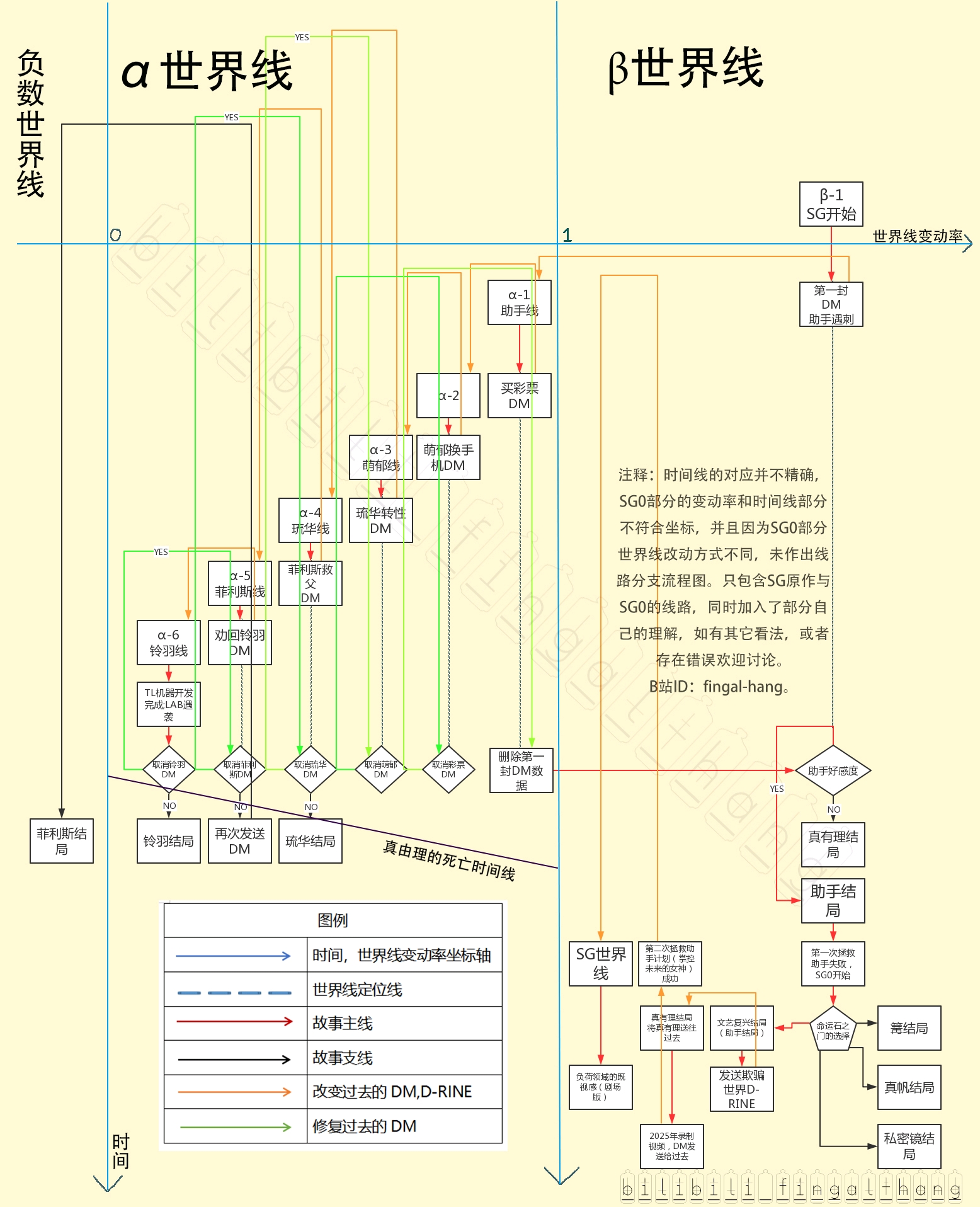
Here's the chart—right-click and open in new tab for the HD version. It covers both the main story and Steins;Gate 0. Didn't include the tree diagrams, Phenogram, or Darling spin-offs; this focuses purely on the mainline logic.
II. Six Key Notes on the Flowchart
You need to understand these premises before reading the chart, or you'll get lost:
1. The axes are schematic only. The relationship between divergence rate and time isn't precise—especially for Steins;Gate 0, which isn't arranged by the axes at all. This isn't an academic paper; as long as you can follow the storylines, it's fine.
2. Why D-mail lines stretch so high. Those upward lines represent how far back a D-mail travels—the higher it goes, the further into the past it reaches. This lets you visually see which email changed which point in time.
3. Only includes main story and Steins;Gate 0. Tree diagrams, Darling, Linear Bounded Phenogram—none of these are included. This is a simplified version based on my personal understanding; real worldline shifts are way more complex.
4. Steins;Gate 0 uses pentagon branches. Since 0's worldline shifts are mainly triggered by the Amadeus system, they can't be shown on a timeline like the main story. So I used pentagons to mark branches. The "Steins Gate" labels inside the boxes don't mean anything special—they're just markers.
5. I integrated the Promised Rinascimento line into the main route. Besides the true ending (Milky-way Crossing), this is the outcome where Okabe sends another message to the past trying to change the world. I separated it from other routes in the chart; I'll explain why below.
6. Known errors. In some places I wrote "Mayuri" as "Mayuri" (different Chinese characters), and "Private Square" as "Private Mirror" (please don't hit me, Kurisu fans). Other errors welcome for correction.

III. Detailed Breakdown of Three Time Machines
Steins;Gate features three types of time machines. Understanding their differences is key to grasping the plot:
1. D-mail/D-rine/D-movie (collectively DM). Send emails/videos to the past, directly changing worldlines and triggering Okabe's Reading Steiner (worldline shift awareness).
2. Time Leap Machine (TL). Sends memories back to your past self, limited to 48 hours. Okabe said this couldn't save Mayuri because the branch points were all before the 48-hour window.
3. Future Time Machine (TM). FG204, C204, etc.—physical time travel. Suzuha rides these.
Here's the key point: Only DM explicitly triggers Okabe's RS, but that doesn't mean the other two can't change worldlines. TM definitely can, and TL actually can too—it's just that each jump creates such tiny shifts that instruments only display to 0.000001, so you can't see it, and it doesn't trigger RS.
IV. Core Worldline Convergence Theory
My understanding is that worldline convergence is essentially causal loops. Every Time Leap accumulates tiny changes; quantity transforms into quality, eventually giving Okabe the conditions to use DM to shift worldlines.
Example:
1. 2010 Akihabara invents time machine
2. Leads to SERN's dystopia in 2036
3. Therefore Suzuha must return from 2036 to change 2010
That's one big loop. Inside this big loop are countless small loops (Okabe repeatedly using TL to trial-and-error), eventually breaking out of the loop to reach the Steins Gate line and start a new causal chain.
That's also why I placed Steins;Gate 0's Rinascimento line in the main story. In this route, Okabe once again sends a message to the past hoping to change the world, and in the Milky-way Crossing ending, he indeed receives that letter. While uncertain if it was sent from the same worldline, it connects the causality into a closed loop.
V. Is Steins;Gate 0 a Parallel World or Actually Happened?
My conclusion: Steins;Gate has no parallel worlds, and there's no such thing as "actually happened." What we see are scenes from specific observers' perspectives; the observed worldline is the only reality.
The main story's observer is Okabe—he won't gain Steins;Gate 0's memories. In the end, he receives a D-movie sent from the future Steins;Gate 0 Okabe, then changes the world. Just like when he received the lottery D-mail before July 28, 2010—he didn't have future memories, that future was simply erased. Only when time flows to the sending moment can you use RS to gain the memory of sending that DM.
After reaching the Steins Gate line, can Okabe use RS to remember Steins;Gate 0? I don't think so. Because the Steins;Gate 0 Okabe left 2025 in a time machine, taking his memories and RS ability with him. This is the question of who is the observer—the DM sender or receiver.
VI. Summary and Steins;Gate Lore Discussion
Above is my understanding of Steins;Gate—definitely has mistakes and gaps. But this explanation holds together, and with the flowchart it connects the plot.
If you made it this far, you're a true Lab Mem. Welcome different perspectives for discussion. For the sake of Steins;Gate lore, cheers with this Dr. Pepper.






Publish Comments