

Many beginners playing Japanese mahjong (or Mahjong Soul) find that the most frustrating part isn't losing, but losing without understanding why. Why can't you win even when you're ready? How come a good hand has no yaku? What do terms like Riichi, Dora, and Furiten even mean? Don't worry—this guide will clear up all your confusion at once. I've compiled all the pitfalls I've fallen into and my practical experience to help you go from zero to actually understanding the game, avoiding detours and improving quickly. Remember, Japanese mahjong isn't a luck game—you need to understand the rules before you can talk strategy.
1. Basic Tiles and Terminology (The 136-tile composition)
2. Core Concepts Explained (Naki, Furo, and tile efficiency)
3. Five Key Japanese Mahjong Rules (No yaku no win, Riichi, Dora, Furiten, draws)
4. Beginner Strategy Tips (Essential tactics for four-player games)
5. Special Yaku and Draws (Four consecutive Riichi)
6. Four-player vs Three-player Mahjong (North tile rules explained)
1. Basic Tiles and Terminology
There are 136 tiles total, divided into two main categories. Number tiles are Manzu (characters), Pinzu (dots), and Souzu (bamboo), abbreviated as m, p, s, with four of each from 1 to 9. Honor tiles are East, South, West, North, and the three dragons (White, Green, Red), also four of each. That's it—just memorize this.
Yaochuu tiles refer to 1 and 9 tiles in number suits (1m,9m,1p,9p,1s,9s) plus all honor tiles. Ron'yao tiles specifically mean only the 1 and 9 number tiles, not including honors.
Bakaze and Jikaze are crucial. The East/South/West/North displayed in the center panel is the prevailing wind (bakaze). The direction you're sitting at is your seat wind (jikaze). For example, in South Round 1, the prevailing wind is South, and your seat wind depends on where you sit.
Discard pool (Kawa) and wall—know the difference. The discard pool is the pile of tiles in front of you that you've discarded; the wall is the stack of tiles waiting to be drawn.
One turn (Iijun) is simple—it's from when you discard this time to when you discard next time.
Discarding is either manual discard (hand-cut) from your hand, or discard-what-you-draw (draw-cut). Online mahjong auto-pilot's discard options are basically automatic draw-cut.
2. Core Concepts Explained
Naki means calling tiles (Chi, Pon, Kan). Online auto-pilot's Naki options default to not calling anything—don't be foolish enough to leave it on.
Menzenchin means completely closed hand, no open melds. Ankan (closed kan) doesn't count as Naki, so it doesn't break menzenchin.
Furo are tiles obtained from others after calling melds. Closed kan doesn't count as furo but triggers some special conditions. Closed kan can break ippatsu, double riichi, and tenhou—only Kokushi Musou (Thirteen Orphans) can rob a closed kan. Furo reduces the han value of some hands, breaks some yaku, and reveals your hand direction.
Mentsu are the basic units of hand composition, including sequences (shuntsu), triplets (koutsu), and kans. Incomplete ones are called incomplete mentsu, divided into three types:
1. Pair (toitsu), two identical tiles
2. Ryanmen (two-sided wait), two tiles that need one more to become a sequence, e.g., 45m waiting on 3m or 6m
3. Penchan (edge wait) are 12 or 89, only waiting on 3 or 7. Kanchan (middle wait) is missing the middle tile, e.g., 46m waiting on 5m
This theory is the core of tile efficiency. Shanten number (steps away from ready) is completely different from number of waiting tiles (how many tiles you can win on).
Suji tiles refer to number sequences like 147, 258, 369. Outside suji, middle suji, and half suji are defense theories, used with wall tiles, safe tiles, and visible tiles. When defending, keeping suji tiles is safer.
Basic winning hand shape is fixed at 4 mentsu + 1 janto (pair), that's the formula.
Honitsu/Chinitsu are collectively called "tanyao" or flush hands.
Hoju (pronounced chòng) means dealing into someone's winning hand.
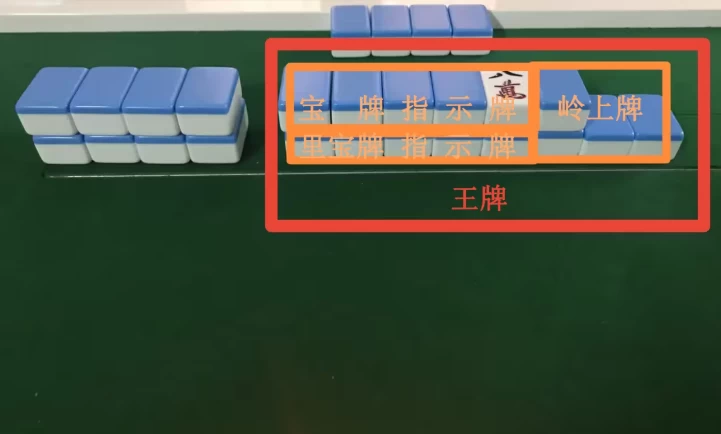
Rinshanpai are the 4 tiles reserved for the player who declares kan, placed in front of the dora indicator. After drawing rinshanpai, you draw one tile from the back of the wall to the dead wall.
Dead wall (Wangpai) always maintains 14 tiles, including rinshanpai, dora indicator, and uradora indicator. Players cannot draw from the dead wall except when declaring kan.
3. Five Key Japanese Mahjong Rules
These five points are the biggest differences between Japanese mahjong and other variants—not understanding these means you're playing for nothing.
First, No Yaku, No Win. When winning, your hand must have at least one yaku, otherwise you can't win even with a great hand. Robbing a kan, rinshan kaihou, haitei, houtei are four exceptions where you can win without yaku.
Special note: To win with Suankou (Four Concealed Triplets) you must win by self-draw (tsumo). Ron win only counts as sankou (three concealed triplets). Tsumo itself isn't always a yaku—menzenchin tsumo is the yaku.
Second, Riichi Mechanism. When menzenchin and ready to win, you can pay 1000 points to declare Riichi. After declaring, you can't change your wait, and discarding becomes auto-piloted. Winning adds +1 han, and if you win within one turn after declaring with no calls, ippatsu adds another +1 han.
Third, Dora System. Dora comes in three types: Dora, Uradora, and Red Dora. The top-left shows five dora indicators, one revealed at start, and one more revealed each time a kan is declared. The next tile in sequence is dora: 1234567891, EastSouthWestNorthEast, WhiteGreenRedWhite. The tile below the indicator is Uradora with the same rule.
Red Dora are red 5s (5m, 5s, 5p), one of each. Online mahjong shows dora with sparkle effects. Each dora adds +1 han, but Uradora only counts if you win with Riichi. Duplicate dora indicators stack. Dora themselves don't count as yaku.
Fourth, Furiten Rule. Furiten comes in three types and is core to defense.
1. Discard furiten: If any of your waiting tiles are in your own discard pool, you're furiten
2. Turn furiten: If someone discards your winning tile and you don't claim it, you're furiten for that turn, cleared after your next discard
3. Riichi furiten: After Riichi, if someone discards your winning tile and you don't claim it, you're permanently furiten
Ready hand without yaku triggers turn furiten. When furiten, you can only win by self-draw.
Fifth, Draw (Ryuukyoku) Mechanism. Special draws come in four types: Four winds discard, four kans, nine terminals, four riichi. Normal draw is when the wall runs out.
1. Four winds discard: First turn, all four players discard the same wind tile with no calls, forced draw
2. Four kans: Four kans total declared, if no one wins after the fourth kan's discard, it's a draw. In competitive rules, fifth kan isn't allowed
3. Nine terminals: Before your first turn with no calls, if you have nine or more different terminal/honor tiles, you can choose to draw
4. Four riichi: When all four players successfully declare riichi, immediate draw. Riichi sticks stay for next hand
Special yaku Nagashi Mangan is extremely difficult—all your discards must be terminal/honor tiles and not called, and you must win with mangan when the wall runs out.
4. Beginner Strategy Tips
Four-player beginners, don't just chase Tanyao (All Simples). Try more Riichi and menzenchin with various hand types. Tanyao only adds han, it's not a main yaku.
If you accidentally call terminals/honors and end up yaku-less, quickly switch to other yaku. Sanshoku doujun/kou, Chanta/Junchan, Toitoi, Honitsu/Chinitsu, Ikkittsukan, Yakuhai (wind/dragon tiles) can all be open.
Remember, Japanese mahjong uses half-hanchan system. East round (four hands) + South round (four hands) is standard half-hanchan. Mahjong Soul's four-player South and three-player South are half-hanchan, four-player East and three-player East are only East round. If the leader doesn't reach 30,000 points in the final hand, it goes to South round or West round until the target is met.
5. Special Yaku and Draws
Three-player mahjong rules differ—remember three points: No 2-8 manzu, no chi allowed, 8 rinshanpai. In three-player you can draw north—reveal north tiles as dora and draw a rinshanpai. Others can ron when you draw north.
6. Four-player vs Three-player Mahjong
Other terms like busting the dealer, reverse first place, complete defense, missed win, dealer continuation, and score calculation aren't critical enough to elaborate here. Look them up yourself and learn through practice.






Publish Comments